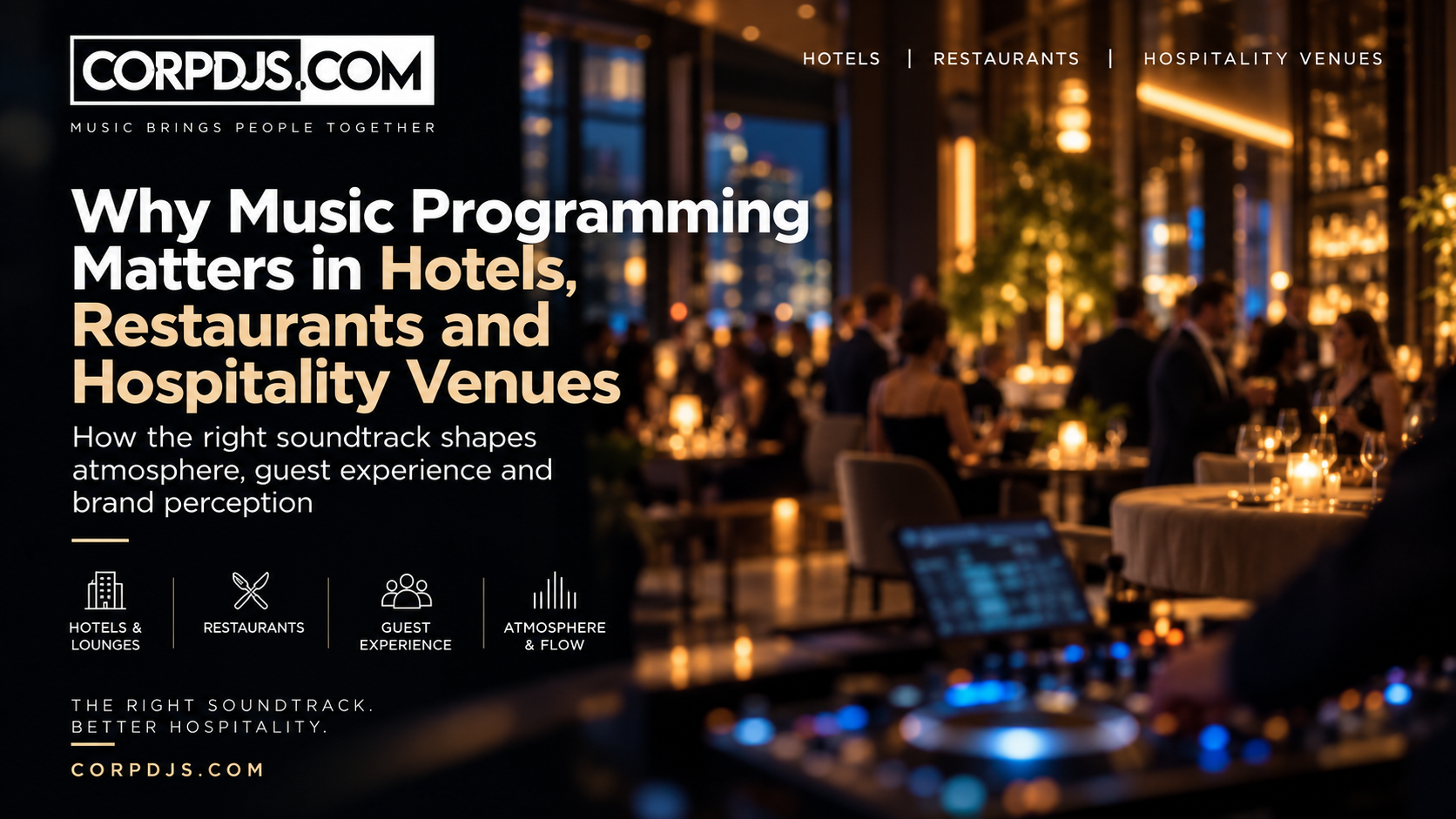
Music is one of the most influential elements of a hospitality venue's atmosphere.
It can change how customers perceive a space, how comfortable they feel and whether the environment encourages conversation, relaxation or celebration.
Yet music programming is sometimes treated as an afterthought.
A restaurant invests in interior design, lighting, furniture, service standards and presentation, only to rely on a generic playlist that has little relationship to the experience it is trying to create.
At CorpDJs, we approach music differently.
Having worked across hospitality, nightlife and private events, we understand that successful music programming is about more than selecting popular tracks.
It is about understanding the venue, its customers and the atmosphere it wants to establish.
The Relationship Between Music and Customer Experience
Two venues can offer similar food, service and interiors yet create completely different experiences through music.
Imagine a hotel lounge during the early evening.
Guests are arriving after work. Some are having drinks before dinner. Others are holding conversations or informal meetings.
In this environment, the music should support the atmosphere without competing with it.
A carefully programmed selection of soulful house, smooth R&B or relaxed Afro House might suit the setting.
Now imagine the same location hosting a late-evening private celebration.
The audience, purpose and desired energy are completely different.
A stronger open-format selection may become appropriate, with familiar music and more energetic transitions.
The equipment may remain the same.
The audience's expectations have changed.
Professional music programming should recognise that distinction.
Why One Playlist Cannot Serve Every Venue
Hospitality environments differ considerably.
A hotel cocktail bar, an upscale restaurant, a shisha lounge and a corporate reception might all require music, but they do not necessarily benefit from the same programming.
Hotel lounges
Music often needs to create a consistent atmosphere while allowing guests to socialise comfortably.
Restaurants
The selection should reflect the brand, dining experience and time of service. Music suitable for an energetic Friday evening may be inappropriate during a quieter weekday lunch.
Shisha and late-night lounges
These venues can attract culturally diverse audiences with distinct musical preferences. Programming may involve Afrobeats, Arabic music, Kurdish music, R&B, Amapiano or other genres depending on the clientele.
Corporate hospitality
Brand presentation, guest demographics and the event schedule should influence the musical direction.
There is no universal formula.
The correct approach begins with understanding the people using the space.
Why Reading the Room Is Essential
A professional hospitality DJ needs to recognise when the audience is responding positively and when the atmosphere requires adjustment.
That does not mean changing genres every few minutes.
In many settings, subtle changes are more effective.
A slightly different rhythm.
A more recognisable track.
A gradual increase in energy.
A transition towards a genre that better reflects the people arriving.
This is where live DJ programming can offer an advantage over a predetermined playlist.
An experienced DJ can respond to the venue as it changes throughout the evening.
A restaurant might begin with relaxed background music before developing into a more energetic bar atmosphere.
A lounge might attract an older audience early in the evening before a younger crowd arrives later.
The music can evolve without losing the venue's overall identity.
Multicultural Music Programming in Birmingham
Birmingham's hospitality industry serves an exceptionally diverse population.
For DJs, that creates both an opportunity and a responsibility.
An audience may contain guests with different cultural backgrounds, musical preferences and expectations.
A venue might want a combination of:
Afrobeats and Amapiano
Commercial R&B and Hip-Hop
UK Garage and House
Dancehall and Bashment
Arabic and Middle Eastern music
Kurdish and Iraqi music
Bhangra and South Asian music
Reggaeton and Latin music
Familiar international party anthems
The challenge is not simply having access to these genres.
It is knowing when and how to introduce them.
In some environments, a highly focused cultural music programme is appropriate.
In others, the audience responds better to an open-format approach that moves between different styles.
The venue's identity and customer expectations should determine the direction.
Music Programming Should Follow the Venue's Schedule
One of the most useful approaches is to consider the different stages of a typical service.
Early Evening: Establish the Atmosphere
At the beginning of the evening, the objective may be to create a welcoming environment.
Guests arrive, staff prepare for busier service periods and the room gradually fills.
The music should complement that progression.
Peak Service: Maintain Consistency
During peak dining or hospitality service, sudden changes in volume and musical intensity can become distracting.
A consistent musical identity helps the venue feel coherent.
The appropriate tempo and volume will depend on the environment, but guest comfort remains a priority.
Late Evening: Adapt to the Audience
As the venue becomes busier or transitions towards a more social atmosphere, the music can develop.
Some venues benefit from a stronger rhythmic selection.
Others need to maintain a relaxed identity throughout the evening.
A professional DJ should understand when increased energy is appropriate and when restraint produces a better result.
The DJ Should Understand the Venue's Brand
A DJ represents more than themselves when performing at a hospitality venue.
Their presentation, professionalism, music selection and interactions with guests become part of the customer experience.
For established hospitality brands, consistency is particularly important.
The music should reflect the environment rather than the DJ's personal preferences alone.
A venue with a refined, understated identity may require subtle mixing, controlled transitions and an appropriately presented DJ setup.
A lively entertainment-led venue may encourage faster transitions, audience interaction and more energetic programming.
Neither approach is inherently superior.
The important consideration is suitability.
Why Professionalism Matters Beyond Music Selection
Successful hospitality entertainment also depends on operational reliability.
A DJ should understand the booking arrangements, arrival requirements, equipment provisions and any venue-specific restrictions.
Communication with management and staff is essential.
For venues booking DJs regularly, consistency becomes especially valuable.
Management should not need to explain the basic musical direction repeatedly.
A clear brief, established standards and dependable communication make it easier to maintain the desired atmosphere across multiple bookings.
This is particularly important when different DJs cover separate dates.
A professional entertainment provider should be able to understand the venue's requirements and communicate those expectations clearly.
Choosing the Right DJ for Your Hospitality Venue
Before appointing a DJ or entertainment supplier, venue managers should consider several questions.
Does the DJ understand the difference between background programming and performance-led entertainment?
Can they work across the genres preferred by your customers?
Are they comfortable adapting to changes in the audience?
Can they maintain appropriate volume levels?
Will their presentation suit the environment?
Do they understand the operational demands of hospitality?
For recurring bookings, is there a clear process for communicating expectations and managing cover arrangements?
A successful entertainment arrangement depends on much more than technical mixing ability.
Hospitality DJ Services With CorpDJs
CorpDJs is a Birmingham-based DJ and entertainment business providing professional services for hospitality venues, corporate events, private functions and branded experiences.
Founded by DJ and entrepreneur Anish Parmar, CorpDJs combines practical experience in nightlife and hospitality with a commercially focused approach to entertainment.
Our experience includes performances at venues associated with brands such as NQ64, Las Iguanas and Turtle Bay, alongside independent hospitality environments.
We recognise that every venue has its own audience, brand identity and operational requirements.
For that reason, our approach is built around adapting the music to the environment rather than imposing the same performance style on every booking.
Whether the requirement is relaxed hotel-lounge music, international open-format entertainment or a more energetic evening programme, the starting point is understanding the venue.
Create the Right Atmosphere for Your Venue
Music should never feel disconnected from the experience a hospitality business is trying to deliver.
When programmed thoughtfully, it becomes part of the venue's identity.
When handled poorly, it can undermine an otherwise carefully designed environment.
The objective is not simply to make the music louder, faster or more recognisable.
It is to make the environment feel right.
For hospitality managers seeking professional DJ entertainment in Birmingham or elsewhere in the UK, CorpDJs can discuss suitable music programming, event requirements and booking arrangements.